


Monday, October 25, 2010


Thursday, October 14, 2010
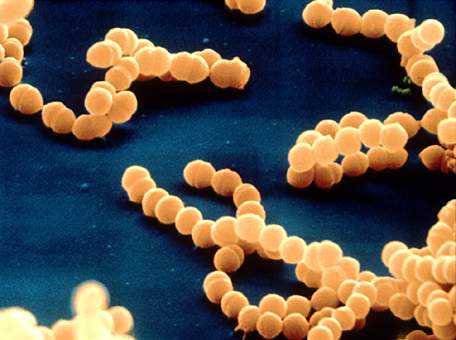
Streptococcus

Streptococcus is a member of the lactic acid group, and is very common in humans. Group A streptococcus otherwise known as (GAS), can cause different diseases, the most widely known being strep throat. Strep throat is caused when the bacteria enters your nose and makes its way down to your throat. The symptoms include: sore throat, swollen tonsils, nausea, and possibly even yellowish-white spots on the back of your throat. The bacteria may also travel from your nose to an infected wound or sore on your skin, which can cause necrotizing fasciitis more commonly known as the flesh eating disorder. Which does literally what the name implies, eats away at your flesh. However this is very rare.
Group B streptococcus known as (GBS), can be found in the urogenital tracts and rectums of pregnant women. This can be transmitted to the child during birth, which can cause meningitis, which could cause the child to lose his hearing or possible even his life. The symptoms of neonatal meningitis are vomiting and fever, both common in young children. Therefore the symptoms can easily be overlooked and if untreated will result in death. Group B streptococcus can also cause pneumonia. Pneumonia causes inflammation of the lungs, and causes them to fill with liquid. Symptoms include coughing, chest pains, fever, and difficulty in breathing.


Sites:
- http://www.wisegeek.com/what-is-streptococcus-bacteria.htm
- http://en.wikipedia.org/wiki/Necrotizing_fasciitis
- http://en.wikipedia.org/wiki/Streptococcus
- http://www.dhpe.org/infect/strepa.html
- Image 1: http://microbewiki.kenyon.edu/images/0/05/Strep.jpg
- Image 2: http://www.webdoctoradvice.com/wp-content/uploads/2010/09/Pneumonia.jpg
- Image 3:http://www.freerepublic.com/focus/f-news/2459204/posts

Friday, October 8, 2010
Macromolecule Lab Reflection

Friday, October 1, 2010
Wednesday, September 22, 2010
The Properties of Water
 From class work and through some reasearch, I have found that water has four main properties: adhesion, cohesion, density,and polarity. However each one of those categories has a sub-categorie. Adhesion has capillary action, cohesion has surface tension, density has specific heat, and polarity contributes for water being the universal solvent. Adhesion is the ability to stick to other things, and an example of capillary action is when someone puts a straw in water the water goes up through the straw, this is because water is adhesive and the water molecules stick to the straw molecules. Cohesion in terms of water is when water molecules come together an stick to other water molecules. Because water is very cohesive it creates surface tension at the top and things like a paperclip that have a greater density than water and should sink, actually are held at the top by that tension. The density of water is 1, and anything with a greater density will sink, and anything with a smaller density will float. Specific heat is related to this because it is the "amount of energy used to raise 1 gram of a substance 1 degree celsius. Last but not least we have polarity, water is polar because of the hydrogen bonds that form intbetween covalent bonds, because of these bonds, water has a slight negative and a slight postive charge which allows it to dissolve many more things than any other solvent.
Monday, September 13, 2010
First Post
During this course, throughout the school year I hope to further my knowledge of different diseases, medicines, evolution and biology in general. Also from this course I hope to become more independent, improve my note-taking skills, and become a better writer through the many different blogs I will write this year. A good example of a web tool that will help me achieve some of these goals is the Internet. At times when I’m working at home and I don’t have a teacher readily available to answer a question I may have I can turn to the Internet for some help. Another example is email or iChat, if I have a question or am confused on something I can turn to my piers for some help. With the help of those two things I believe that I should be able to achieve each of my goals for bio this year.
Subscribe to:
Posts (Atom)